Admission criteria
Your file is your exam. Here is exactly what it must contain.
There is no Romanian national entrance examination on the international route. Selection is file-based, in two stages — Thumbay pre-selection in the UAE, then holistic evaluation by the UMFST admission committee.
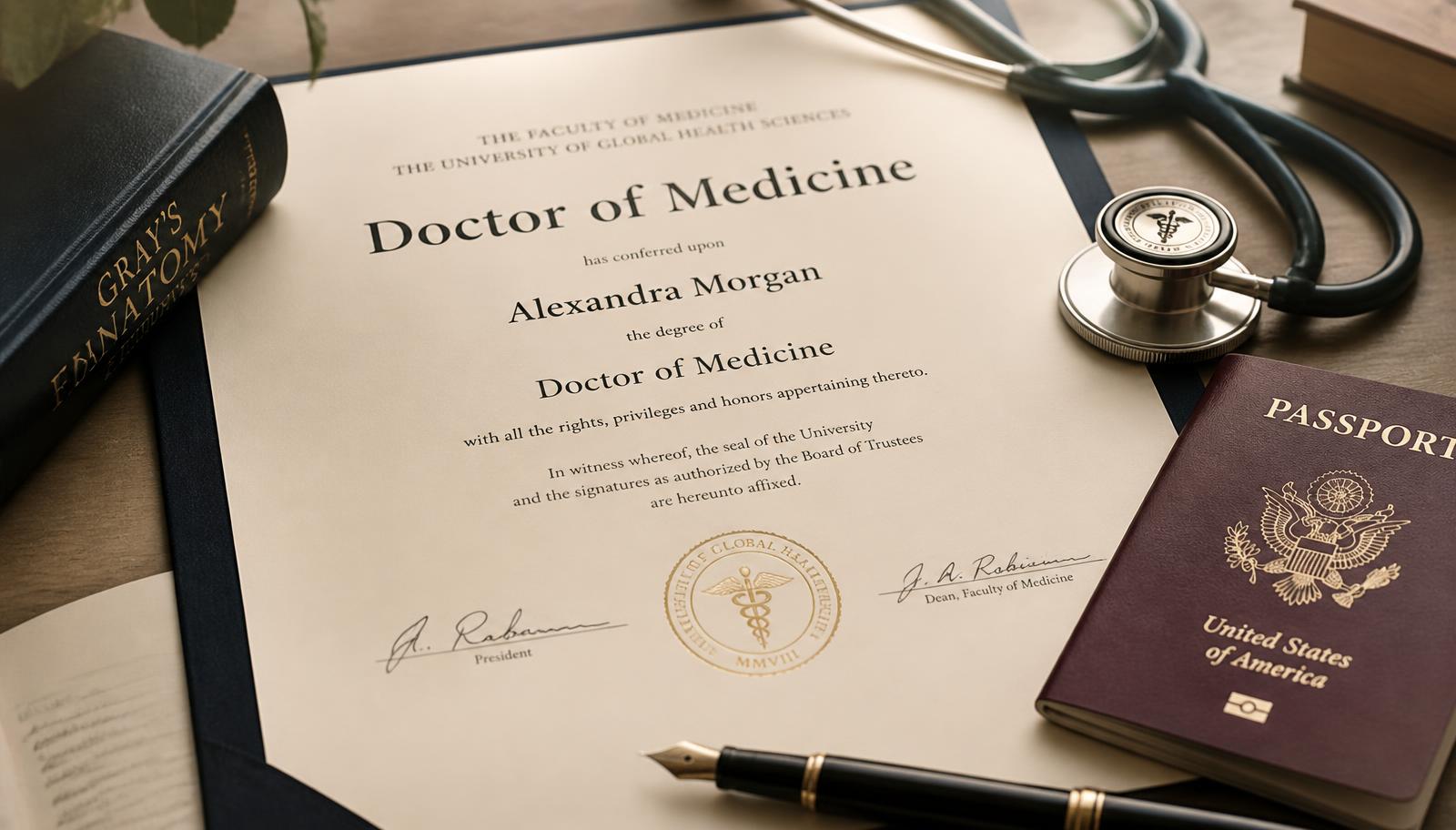
1. Eligibility requirements
- —MBBS, MD, or equivalent primary medical qualification from a WHO-recognized medical school, recognized by the relevant regulatory authority and eligible for recognition by the Romanian authorities.
- —Official academic transcripts for the full program of study.
- —Minimum cumulative GPA of 2.75/4.0 or equivalent — the Thumbay pre-selection benchmark. The UMFST admission committee evaluates academic performance holistically and applies no separate published cutoff.
- —Application within two years of graduation. Graduates of the GMU College of Medicine form the primary intake; graduates of other recognized schools are welcome to apply.
- —Applicants beyond the two-year window may be considered on the strength of recent, documented clinical experience.
2. Romanian language requirements
Residency training in Romania is conducted in the Romanian language, as required by Romanian regulation. Prior to enrollment at UMFST, applicants must satisfy one of the following:
- 1.A recognized certificate of Romanian language proficiency at minimum level B2 (CEFR); or
- 2.Successful completion of a Romanian language preparatory program at an accredited Romanian higher-education institution — typically six months to one year; or
- 3.Exemption: at least three consecutive years of study completed at an accredited Romanian higher-education institution.
An English language certificate is also required — the pathway's academic modules, simulation training, and interviews are conducted in English. English is for the pathway phase; Romanian is for the residency.
3. The document set
Everything must be in English, French, or Romanian — or notarized translations attached to authenticated copies of the originals. Start attestations and translations first: they take the longest and are the single most common cause of delay.
- —Completed online application
- —Medical degree certificate
- —Official academic transcripts — every year of study
- —CV, submitted in advance of the interview, including volunteering, internships and mobility programs
- —Specialty-focused motivational essay
- —Three specialty options, ranked in order of preference
- —Two recommendation letters from professors or coordinators of medical-profile modules you took part in, relevant to your chosen specialty
- —Passport copy and passport-size photograph
- —English language certificate
- —Evidence of Romanian language proficiency or an enrollment plan for the preparatory program
- —Professional registration and Good Standing Certificate, where applicable
4. Two-stage selection
Stage one — Thumbay
- 1.Administrative screening — completeness and eligibility
- 2.Academic evaluation — the portfolio: GPA, clinical experience, research, service and leadership
- 3.Multiple Mini Interview — clinical reasoning, ethics, communication, motivation
- 4.Final evaluation and recommendation to UMFST
Stage two — UMFST committee
- 1.A single admission committee, common to all specialties
- 2.Holistic evaluation: grades, letters, CV and interview, read as a whole — no separate scores
- 3.All candidates ranked
- 4.Allocation down the ranking — each candidate receives the highest of their three stated choices still available
5. The interview
The interview is conducted individually, in person or online, and lasts approximately 15 minutes before a committee of two (maximum three) members from those in charge of the selection procedure. It is documented on a written evaluation sheet, archived with your file, and results in a favourable or unfavourable recommendation.
What the committee assesses
- —Motivation for the chosen specialty and consistency of your reasoning
- —Determination to complete a demanding, multi-year training programme
- —Academic and professional background relevant to the specialty
- —Commitment to acquiring a functional level of Romanian within a short-to-medium timeframe
- —Professional maturity and understanding of ethical and clinical responsibilities
- —Intention and practical capacity for long-term involvement in Romania throughout training
- —Adaptability to the Romanian healthcare and academic environment
- —Alignment between your expectations and the training capacity available
6. CV, letters & motivation essay
Submit your CV in the Europass format, the standard CV format used across the European Union. You can create and download a Europass CV free of charge at europass.europa.eu — it is available in English and offers a guided, structured template. For recommendation letters no template is imposed: you and your referees may use any format.
There is no prescribed length for the motivation essay. What is expected is a clear and personal answer to two questions:
- 1.Why this specialty? Explain the reasons behind your choice, what draws you to the field, how the interest developed (clinical experiences, mentors, academic work), and how it fits your professional vision.
- 2.Why are you suited for it? Present the strengths that recommend you — relevant clinical exposure, academic achievements, research activity, technical or interpersonal skills, and personal qualities aligned with the demands of the field.
7. Admission calendar
Applications open now — first cohort admissions complete by 15 October 2026.
UMFST is ready to receive and evaluate applications immediately, so the application channel opens as soon as files are collected in the Gulf region. The admission process for the first cohort is scheduled to be fully completed by 15 October 2026, allowing admitted candidates to begin the first module of the Romanian language preparatory programme immediately thereafter.
8. Visas & immigration
Visa applications are the personal responsibility of each candidate and are processed by the Romanian diplomatic mission in your country of residence. Admitted non-EU candidates apply for a Romanian long-stay visa for studies, followed after arrival by a residence permit issued by the General Inspectorate for Immigration.
UMFST is not the visa-issuing authority, but it supports its international residents throughout: the university issues the official documents required for the application (letter of acceptance / enrolment confirmation and supporting attestations), and its staff guide candidates through the steps.
The number of places available for international residents in UMFST accommodation, and an estimated monthly range covering accommodation and general living costs in Târgu Mureș, are being confirmed with the university administration and will be published here.
9. Accreditation & the specialist title
- —Residency training in Romania is regulated and accredited nationally by the Ministry of Health together with the Ministry of Education. All specialties follow the official national curricula, and training takes place exclusively in clinical units accredited for residency education. UMFST G.E. Palade Târgu Mureș is a fully accredited state university, evaluated by ARACIS — a full member of ENQA and listed in EQAR, the European quality assurance register.
- —On completing residency you sit the national specialist examination (examenul de medic specialist), organised by the Romanian Ministry of Health. The specialist title is awarded by order of the Minister of Health.
- —Registration and the licence to practise as a specialist are administered by the Romanian College of Physicians (Colegiul Medicilor din România).
10. Three things that sink files
- —Generic recommendation letters — they must be specialty-relevant, from people who actually supervised you.
- —Transcripts missing a year of study.
- —Starting Romanian too late. Preparatory routes run six to twelve months; begin in week one.
Print the one-page application checklist
Tick every box before you submit. Unsure on any point? The eligibility consultation is free — ask before you self-reject.
Questions about specific documents? Read the FAQ.