The university & the city
Where you'll train, and where you'll live
George Emil Palade University of Medicine, Pharmacy, Science, and Technology (UMPhST) of Târgu Mureș — nearly eighty years of academic tradition, in a Transylvanian city that grew around its medical school.
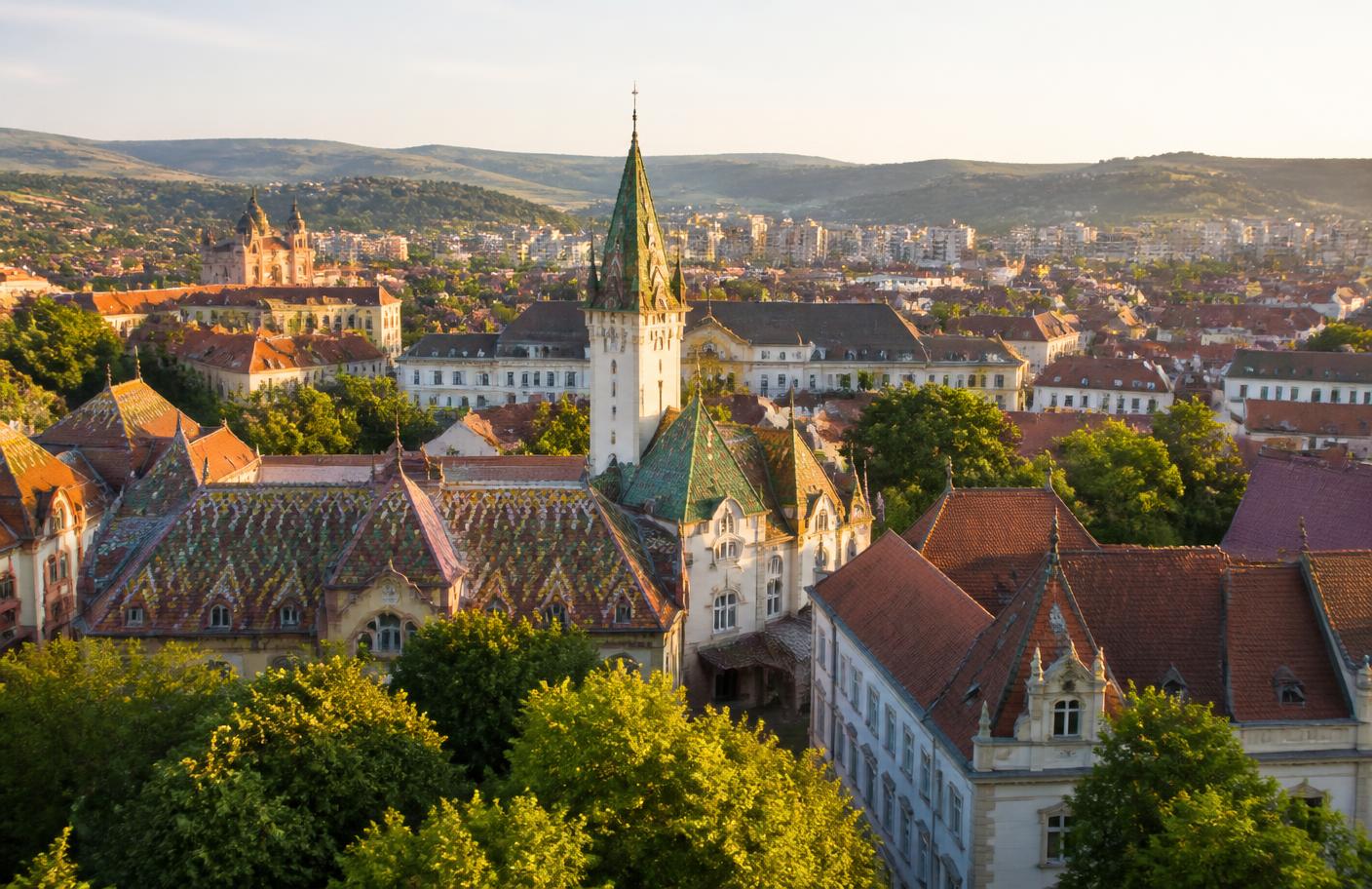
The university
G.E. Palade UMPhST of Târgu Mureș was established almost eight decades ago and is recognised both nationally and internationally. Nearly 13,000 students — more than a tenth of the city's population — are enrolled across its seven faculties in undergraduate, master's, doctoral, and residency programmes. Teaching is delivered in Romanian, English, and French, and the university's stated identity is a multicultural one: E pluribus unum.
The curriculum keeps a traditional core while aligning continuously with the skill demands of the global labour market. Students take part in Erasmus+ mobilities and the international SCOPE and SCORE exchange programmes, and the university runs an active internationalisation agenda — including its own branch campus in Hamburg, Germany. Residency at UMFST means training inside accredited teaching hospitals, under the national framework of the Romanian Ministry of Health.
- 1945
- First medical university in the city
- ~13,000
- Students today
- 7
- Faculties
- 10%
- Of the city's population is a student
Institutional history
Nearly eighty years, still building
- 1906–1907The university's headquarters is built in secessionist (Art Nouveau) style to a design by the Grünwald brothers, opening in 1909 as a military school.
- 1945The University of Medicine and Pharmacy is founded — the first university in Târgu Mureș.
- 2019The Hamburg campus (UMPhST–UMCH branch) opens in Germany, teaching the Târgu Mureș curriculum to Western European standards.
- 2022A new university extension opens in Bistrița.
- 2024The university establishes its own high school, preparing future students on its own campus.
- In progressConstruction of the George Emil Palade Clinical Hospital and a Competence Development Centre for public-health personnel.
Source: umfst.ro — university profile and institutional history.
The city
Târgu Mureș is a compact, green, and safe university city in the heart of Transylvania, long recognised for its educational tradition — the first documented school within today's Romanian borders, Schola Particola, stood in its medieval citadel, and the country's first public library was founded here in 1802 under Teleki Sámuel. Living costs are among the lowest in the European Union, so training years cost a fraction of what they would in Western Europe.
Culturally the city is defined by the Palace of Culture, one of Romania's landmark Art Nouveau buildings. Its Hall of Mirrors stained glass represented Europe at the 1914 San Francisco decorative art exhibition, and its concert hall houses the country's largest organ — 4,488 pipes and three keyboards, still played today.
Accommodation options, indicative rents, and monthly cost-of-living guidance are being confirmed with UMFST and will be published on this page.
Art Nouveau heart
Palace of Culture, Hall of Mirrors, 4,488-pipe organ
Deep academic roots
Schola Particola; first public library in Romania, 1802
Student city
More than 10% of residents are students
Affordable EU living
Among the lowest costs of living in the European Union
Teaching hospitals & clinical sites
Residency training runs across the major clinical institutions of Târgu Mureș, all accredited for residency education and operating under the academic coordination of UMFST. The university is also building the George Emil Palade Clinical Hospital, together with a Competence Development Centre for public health personnel.
SCJU
Emergency Clinical County Hospital Târgu Mureș
Spitalul Clinic Județean de Urgență Târgu Mureș
32 specialties trained here
SCJ Mureș
Mureș Clinical County Hospital
Spitalul Clinic Județean Mureș
20 specialties trained here
IUBCvT
Emergency Institute for Cardiovascular Diseases and Transplantation
Institutul de Urgență pentru Boli Cardiovasculare și Transplant Târgu Mureș
4 specialties trained here
IML
Institute of Legal Medicine Târgu Mureș
Institutul de Medicină Legală Târgu Mureș
1 specialties trained here
UMFST
University clinical & academic departments, UMFST G.E. Palade
Departamentele clinice universitare UMFST G.E. Palade
3 specialties trained here
Each of the 49 specialties is mapped to its teaching hospital, clinical sections, and UMFST-validated coordinator on the Specialties page.
Research, conferences & publications
Training inside a research-active university
Residency at UMFST is embedded in a research-active academic environment. Beyond clinical training, residents in the Pathway have access to university research infrastructure, scientific conferences at university, national, and European level, and structured publication opportunities.
Research infrastructure
Scientific activity is coordinated by the Prorectorate for Research, Development and Technology Transfer. The flagship platform is the Centre for Advanced Medical and Pharmaceutical Research (CCAMF). The university also hosts the British-Romanian Academic Institute of Neurosciences (BRAIN). Depending on specialty, residents may join active groups in vascular biomechanics and tissue engineering, molecular cardiology, oncologic pathology, medical genetics, and clinical pharmacology.
A PhD alongside residency
Romanian legislation allows residents to enrol simultaneously in the UMFST doctoral school (IOSUD-UMFST) and pursue a PhD alongside specialty training — an EU specialist qualification and a doctorate within the same 5–6 years. Doctoral admission is a separate competitive process with its own eligibility conditions, supervision availability, and tuition fees for international candidates.
Funding and participation
Residents can join internal university research grants and nationally funded (UEFISCDI) projects, and clinical departments routinely involve residents in clinical registries, retrospective cohorts, and laboratory work. A realistic progression: co-authorship and data collection in the early years, first-author papers and international presentations by mid-residency.
CCAMF laboratories
- — Cellular and Humoral Immunology (IMUNO)
- — Molecular Biology – Genetics – Genomics
- — Normal and Pathological Morphology
- — Chromatography and Mass Spectrometry
- — Regenerative medicine, tissue engineering, and biomechanics facilities
Conferences
- University-hosted
- The annual Marisiensis International Congress for students and young doctors (spring, Târgu Mureș) is the natural first congress — English-language, multidisciplinary, low barrier to entry. The UMFST–UMCH Research Day with the Hamburg campus is a further recurring English-language venue; accepted abstracts are published as supplements of the university's official journal.
- National congresses
- Each Romanian specialty society holds an annual congress — surgery, cardiology, internal medicine, vascular surgery and others — where residents are expected, and in many departments supported, to present. Many now include English-language sessions with international faculty.
- European congresses
- Because Romanian residency is part of the EU framework, residents integrate into European specialty societies, most offering trainee membership, travel grants, and resident abstract prizes. Târgu Mureș departments have an established record of resident presentations at European congresses.
A resident who engages with the academic life of their department can expect to present at national and European congresses, co-author peer-reviewed publications, and — for those enrolled in the doctoral school — complete a PhD thesis. Research participation is encouraged and supported, but the primary obligation of residency remains clinical training.
Visit umfst.ro